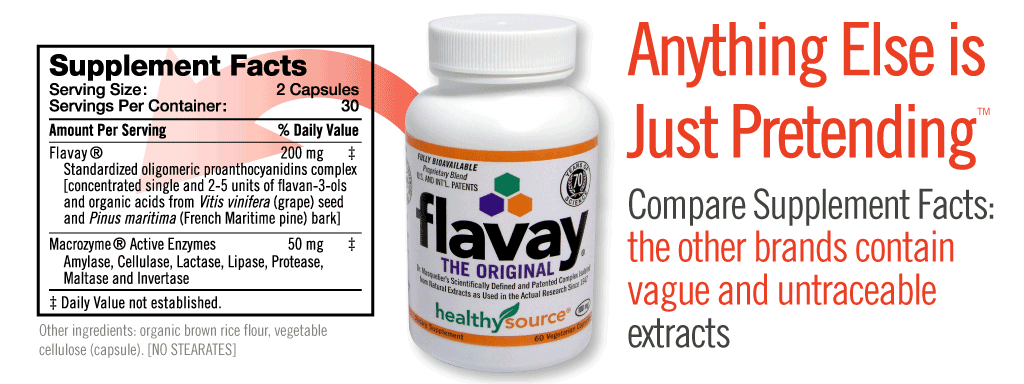
Ambiguous claims like "Finest Quality" or "Standardized" or "Extra OPC" are dubious to the trained observer who is left guessing about the origin and composition of the ingredients, and in which country and according to what standards it was produced.
Consumers need to know that there is no industry standard for accurately identifying and quantifying products sold as OPCs (oligomeric proanthocyanidins) in the marketplace. For example, many "OPC" products claim to be standardized for "polyphenols," but that's not useful because the vast majority of polyphenols are unhealthy for consumption as they prevent nutrient absorption. (89,189-194)
So, because there is no industry standard, most so-called "OPC" products contain unidentified and untraceable extracts typically labeled vaguely as "grape seed extract" or "pine bark extract." Even the trained observer is left guessing about the origin of the ingredients, method of production, and in which country and according to what standards it was produced.
Unfortunately, most so-called "OPC" products contain nothing more than grape seeds or other plant parts which have been pulverized in a food processor—because producing extracts is extremely cheaper, easier and faster than isolating OPCs. Also, manufacturers use chemical solvents rather than water and food-grade alcohol. Manufacturers who actually isolate proanthocyanidins then fail to remove the many large proanthocyanidins from among the small ("oligomeric") proanthocyanidins (the importance of molecular size is discussed below). There is also wide variation between grape seeds used as well as seed separation, drying and storage. All of these differences have significant impact on the final composition--and why most are antinutritive and experts warn that they may be dangerous when taken in large amounts. (89,187,194)
Nevertheless, sellers of these so-called "OPC" products are currently borrowing research conducted on other products to support the efficacy of their own. The differences, if even known by the seller, are conveniently left unmentioned and consumers have little or no means to make the distinction.
OPCs are very complex (much more than other phytonutrients) so there is as much confusion as there are commercial opportunists. The result is pandemic misinformation.
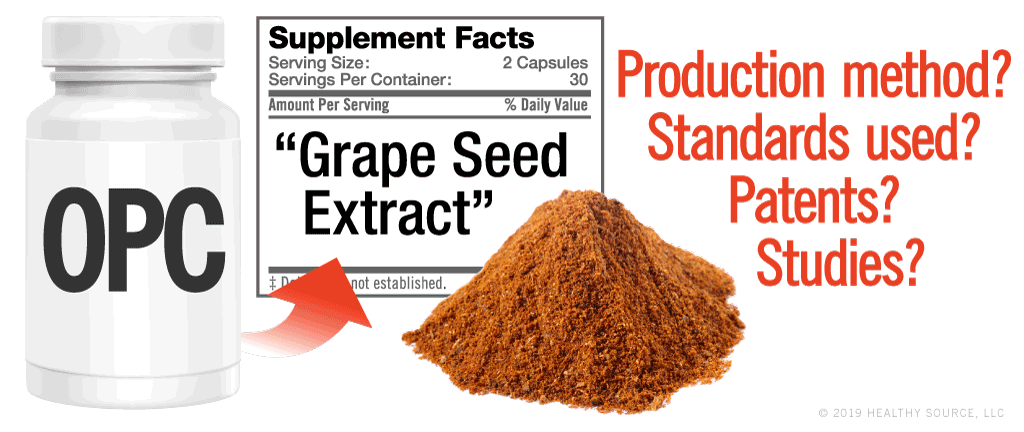
Most so-called "OPC" products contain nothing more than grape seeds or other plant parts which have been pulverized in a food processor. So it's no wonder that experts warn that "grape seed extracts" are "likely to make you sick" in high doses because grape seed extracts typically contain large doses of large proanthocyanidins and bioflavonoids which can be unhealthy for consumption. (192-194,246)
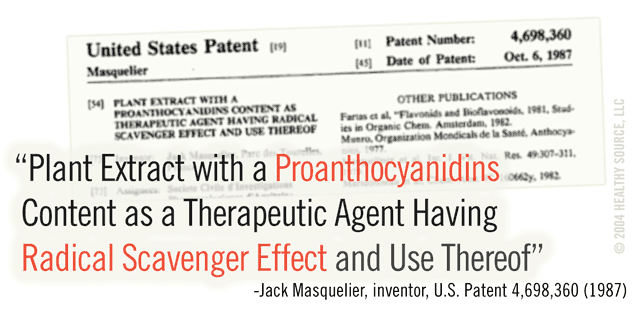
"Certain bioflavonoids are mutagenic at high doses." —Jack Masquelier, et. al, “Flavonoides et pycnogenols,” Int. J. Vit. Nutr. Res., 1979. (89)
Flavonoids sold in high doses, including "grape seed extracts" are "likely to make you sick." —U.C. Berkeley Professor Martyn T. Smith, et al., Free Radical Bio. & Med., 2000. (194)
A commercially-produced "grape seed extract," was found to have prooxidant activity, causing researchers to express caution about its safety and question its benefits. —Antioxidant/prooxidant activity of a polyphenolic grape seed extract. Food Chem. 2010. (187)
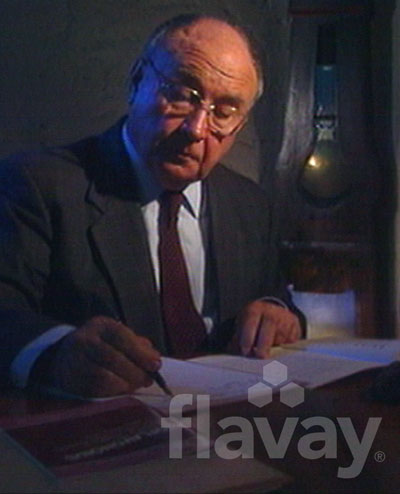
(Above:) Dr. Jack Masquelier (Bordeaux, France), inventor of the patents for the isolation, identification and application of oligomeric proanthocyanidins (known also as pycnogenols).
Whereas grape seed extracts contain bioflavonoids (the subgroup of flavonoids and an enormous and extremely complex and varied category), these are known to be mutagenic in large amounts therefore untested extracts may be dangerous to your health.
However, the highly defined Flavay® has been tested as a medicine for safety. Manufactured in France under the strict standards set forth by the French Ministry of Health, Flavay® has undergone intensive biological, toxicological, pharmacological and analytical research for the purpose of registration as a medicine in France. Rigorous testing to meet the standards required by the health ministries of France, Germany and other European countries demonstrate that Flavay® is 100% bioavailable, nontoxic, nonallergenic, noncarciogenic, nonmutagenic and is completely safe.
In the 1990s, when the American natural foods industry learned about OPCs and of Dr. Masquelier's work in France, they engulfed it under a tidal wave called "grape seed extract" and manufacturers popped up everywhere. But there is no relevant pharmaceutical, nutritional, biochemical or analytical definition of "grape seed extract" nor is there one standardized manufacturing method. There are no commonly accepted, clear analytical "fingerprints" for qualifying grape seed extract. In fact the term is so broad and so vague that "grape seed extract" can and does mean just about anything.
Unfortunately the demand for grape seed extracts was created by using vague and general references to the work of Dr. Masquelier and his colleagues. The tragedy is that the vast majority of purchasers of grape seed extracts, "OPCs," and branded pine bark extract believe they are buying the same product that was invented and researched by Dr. Masquelier and registered in France by the French Ministry of Health. Nothing could be further from the truth.
Oligo (small) Pro (before) antho (plant) Cyanidins (with red pigment).
Oligomeric proanthocyanidins (OPCS) refers to specific plant chemicals which are small and before color (and for that reason, colorless).
Unlike other nutrients which are are comparatively simple, OPCs are very complex and require specialized knowledge and technology in order to be accurately identified and quantified.
Not all proanthocyanidins are healthy for consumption. Only the small proanthocyanidins are healthful, and these are known as oligomeric proanthocyanidins, or OPCs.
Only the small (2-5) clusters of proanthocyanidins are small enough to fit between collagen fibrils and gently protect delicate tissues. (Clusters of 6+ are too large and their affinity for proteins is too strong to be healthful.)
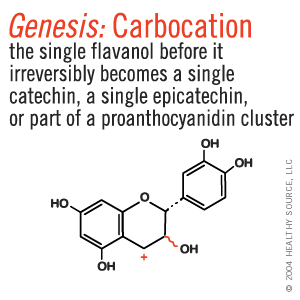
Where the single catechins and single epicatechins are highly beneficial in OPCs, the same molecules are nonnutritive when isolated.
OPCs are highly perishable when isolated from other substances called organic acids. Therefore, Flavay® retains small amounts of these organic acids (including caffeic acid, cinnamic acid, fumaric acid, gallic acid, vanillic acid) as these preserve the OPCs and significantly contribute to the beneficial effects of Flavay®.
Whereas both small and large proanthocyanidins bind to collagen proteins, the large clusters of proanthocyanidins (6+) are so powerful that they crush where the small OPCs (2-5) gently stay in check with the delicacy of the tissues they protect. The large proanthocyanidin molecules cannot pass the intestinal tract into the blood because they are too large to fit between collagen fibrils and unable to repair decayed collagen. (3,4)
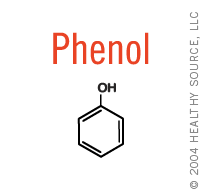
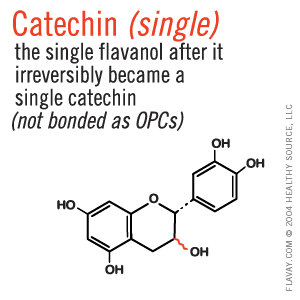
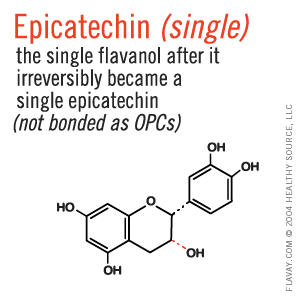
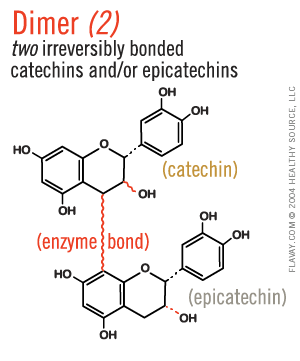
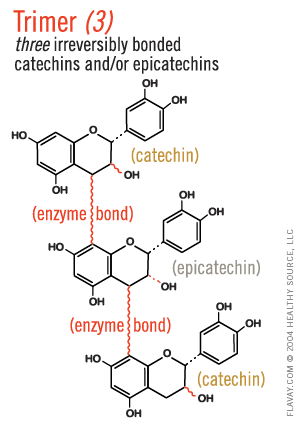
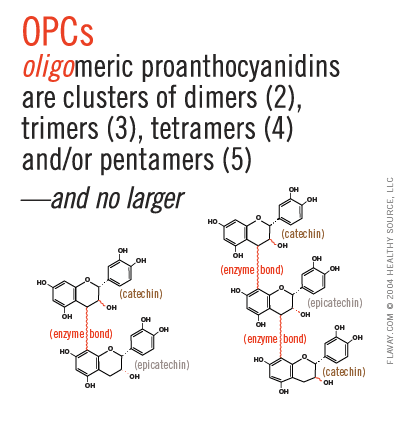
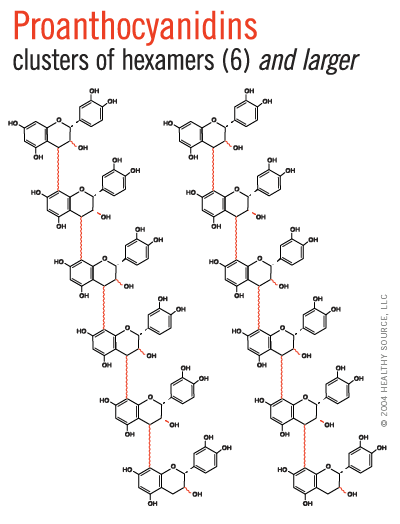
Most importantly, large-clusters of proanthocyanidins are antinutritive and can be unhealthy for consumption. Large proanthocyanidins cause proteins, carbohydrates and nutrients to become indigestible and can result in toxic effects. (192-194,246)
Large proanthocyanidins are known as "tannins" and were traditionally used for tanning leather before natural tanning materials were replaced by chemicals. Today, the large proanthocyanidins are used in production of eco-friendly plastics, resins and adhesives. (195,196)
The vast majority of producers of grape seed extracts (and pine bark extracts) leave the majority of the large proanthocyanidins molecules in their products in order to bulk up the weight and then allow the consumer to wrongly believe they are consuming OPCs.
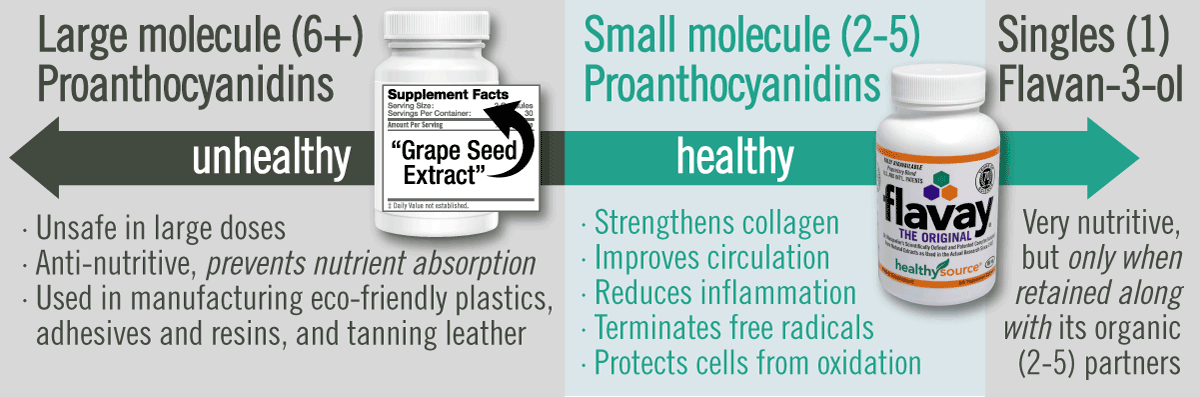
The science of manufacturing Flavay® is complex. Where the single flavan-3-ol molecular groups are highly beneficial, the same molecules are nonnutritive when isolated from their natural partners. So, organic groups of singles and small-clusters of specific molecules are selectively preserved while antinutritive large-clusters of molecules are removed. Organic acids are retained to preserve bioactivity in the otherwise highly-perishable molecular complexes.
More than 70 years of solid scientific research, patents and clinical studies, rigorous manufacturing controls and comprehensive identity-testing safeguard quality and consistency of Flavay®.
Flavay® is the name you can trust for the original, patented and perfected, pure and unadulterated, small-cluster oligomeric proanthocyanidins complex manufactured in France where it has been tested as a medicine for safety and validated by the French Ministry of Health and approved for over-the-counter use.

Flavay is terrific. I've had concentration problems, well, for 60 years, all my life. I couldn't have direct eye contact with people when talking with them because I couldn't concentrate. I told jokes but couldn't make people laugh because I couldn't keep my concentration. Now I can look people in the eye. Now I can make people laugh! I don't know how it works but it works and it is terrific. —Mr. Wayne M.*
My 13-year-old son started taking Flavay for ADD. He came home from school saying, ‘Mom! I felt so smart! I answered all of the questions!’ The teacher backed him up, saying he got every answer correct. So I will keep giving him Flavay. —Ms. Tammy A.*
Flavay works well with my son (6 years-old, with Autism). He's doing work at the proper level, anger issues are gone. —Ms. O.F.*
Thank you so much for all your help. Thank you for also improving my son's lifestyle (taking Flavay). —Ms. R.D.*
I've got to have my Flavay. Keeps me going. Keeps me young. 4 Flavay every day. —Mr. C.S.*
My grandson asked to start taking Flavay again. He is 14 years old and has ADD and anxiety and pain going down his arms and so Flavay must have been helping him because he is asking for it. (Follow-up:) Flavay is working! My grandson is doing so much better in school. No more bad text messages from his teacher. I am so grateful. I'm so happy. —Ms. M.P.*
I’ve noticed I’m more mentally alert and more productive since taking Flavay. —Ms. S.V.*
I have found Flavay to be a wonderful product. I buy it for my mum's eyes, but we also notice it improves her cognitive function. —Ms. N.S.*
I have lupus and taking Flavay enables me to move. I'm not able to do without it. I've been taking it for more than a decade and my skin looks younger, in fact people think I'm my kid's sister. —Ms. L.B.*
Oh, Flavay has been wonderful for my skin. My sister, who is 22 years younger, says she wants to age like me. —Ms. J.P.*
Flavay is the only supplement I've ever used that affects my outward appearance significantly. Initially, benefits to my skin were secondary benefits to me because I was taking Flavay for pain and mobility. Now I take Flavay as much for the benefits to my skin as for joint pain. —Mr. H.S.*
You can tell a difference when you look in the mirror! (taking Flavay for 9 years) —Ms. Lisa L.*
I have used Flavay and Flavay Plus for almost a month and I really have not felt this healthy for so long. Fantastic energy and better overall. I have ms (small letters intentional, I hate it) and am feeling better even at work, people have commented my skin is better than it has ever been. I have great energy, it is incredible. —Mr. G.S.*
After one month of taking Flavay and Flavay Plus, I feel really good. I feel younger, like I used to feel 5 years ago, so that I want to start a business, and other things like that. My wife says I even look different. —Mr. R.K.*
Flavay really helped me with my acne and it really calmed me down. I was very stress-free when I was taking it. —Ms. M.B.*
At 50 years of age I had come up with adult acne, with cysts and scabs all over my face. I've been taking 4 Flavay and 4 Flavay Plus capsules twice a day and in a two-week period my face is clear! ...We own our own business and have been traveling a lot lately, under the stress of a busy schedule, and yet my face just kept clearing up and now it's clear! —Ms. D.G.*
I wanted to let you know that I am already seeing improvements in my skin since using Flavay. I have just placed another order for Flavay. —Mr. Brian T.*
This stuff is amazing! Flavay is really helping me! I have a skin problem and since I've been taking Flavay the blisters have stopped coming and my skin is starting to heal. I've had this problem for many years. I've tried everything, and nothing else worked. —Mr. Wayne H.*
Flavay helps with my skin disease pityriasis rubra pilaris, and it goes away by taking Flavay. I swear by this, it’s wonderful! —Ms. Linda M.*
After 2-3 weeks of taking Flavay I can tell a distinct difference for my eyes. Now, my stainless steel refrigerator looks normal, I don't see irritating waves and or need to blink as before. It's such an easy way for me to gauge what Flavay is doing for my eyes. Also, I see less of a halo around light. I can tell a distinct difference. I'm delighted to see a difference in my skin, too. My aged skin looks a lot better. It's a quality difference in my skin. And I see a huge difference in my mother's skin, a softness that it didn't have before. —Ms. Jane F.*
I want to thank you for Flavay Plus, it's just wonderful. My anxiety, panic and stress levels plummeted and my skin became clear and radiant. —Ms. J.C.*
In taking Flavay and Flavay Plus I really notice in my concentration. It seems to help with that. I can tell a difference. Also, I feel like I look younger when I'm taking Flavay, in my skin and hair, it looks better. I've noticed a big difference in my sleep, I sleep better and I have more energy. Flavay is a wonderful product! —Ms. Lisa L.*
I've taken a lot of other antioxidants and Flavay is the best all-around antioxidant, better than all the other new antioxidants. I can really feel the difference with Flavay. —Mr. E.D.*
I've been taking Flavay for 3 months and a friend told me that she can't believe my complexion! She's just in awe. She said, can I touch your face? and so she touched my face and said, oh my lord! —Ms. D.S.*
My joints aren't hurting and my back feels better and I'm even able to work better. I'll tell you, I can feel Flavay! —Ms. C.V.*
I have lupus and taking Flavay enables me to move. I'm not able to do without it. I've been taking it for more than a decade and my skin looks younger, in fact people think I'm my kid's sister. —Ms. L.B.*
After about 6 to 9 weeks it made a profound difference. I’ve lost inches in swelling. I cannot say enough about Flavay! Over the years, I’ve stopped and started again and found for vascular and lymphatic edema, nothing is better than Flavay. —Ms. Marie D.*
I just want to say that I love Flavay. When I stop taking it, the pain comes right back. —Mr. Mark H.*
I feel flexibility, while tying my shoes, wow! The simple things work better. I feel a general sense of wellbeing with Flavay. —Mr. Peter M.*
I love your product called Flavay. I feel it does the job! —Mr. Robert B.*
I've got to have my Flavay. Keeps me going. Keeps me young. 4 Flavay every day. —Mr. C.S.*
I had a terrible accident where I fell 20 feet and injured my back and it was really bad. I went from a wheelchair to a cane and now I'm mowing the lawn. Flavay shrank the protruding disk so I could stand up straight again. I've referred many many people to your products, and it worked for them too. —Mr. Dave T.*
Flavay is a product I cannot stop taking. When I stopped taking it for a couple of weeks, my neuropathy and arthritis pain come raging back. So I started again on Flavay and the pain is almost completely gone. —Ms. Elsa D.*
I started taking Flavay for arthritis pain and I feel so much better! I'm so thrilled! —Ms. Susan S.*
After taking Flavay for just a week, my sister is doing things she couldn’t do before, such as bending over to pick things up off the floor. —Mr. Joe C.*
The puffiness in my legs is so much better. Oh my gosh this Flavay is great! —Ms. Joan G.*
Your Flavay really helps my husband's chronic pain syndrome and we're almost out! Please ship asap! —Ms. S.W.*
I was taking Flavay for pain and mobility. Now I take Flavay as much for the benefits to my skin as for joint pain. —Mr. H.S.*
Oh, I just love Flavay! I feel so much better! —Ms. Y.L.*
I can’t even tell you how much I appreciated finding your product Flavay and the incredible results and relief I have gotten from taking it... I skeptically ordered two bottles... And low and behold, it works. I read that I could take more than 2 that some people had to take 4 or 5 at a time, so I did, hoping and praying, and my prayers were answered. To say thank-you is an understatement, and I have been able to stop all other pain meds. I honestly was on a one way road to nowhere, now I am free again..a feeling I haven’t had in over 12 years. Thank-you!!!!!!!!!!!!!!! —Ms. Beth B.*
I am a nutritionist and I have referred two of my clients to take Flavay. Both of my clients have raved about the product. One of my clients has a problem with circulation and she said Flavay really works for her. —Mr. John H.*
I've got to have my Flavay. Keeps me going. Keeps me young. 4 Flavay every day. —Mr. C.S.*
My neighbor is so pleased with Flavay telling me how much better she feels. She has heart problems and taking 2 Flavay per day she has so much energy again and her color is better too. —Ms. C.V.*
I have tried everything else and your Flavay really helps my eyesight. I was having trouble seeing at night and now I don't have that problem anymore. I love Flavay. I also had a blown knee that they had wanted to do surgery on and now I don't have to. I love the Flavay, I really like it! —Ms. T.K.*
I start feeling pain in my joints after a few days of not taking Flavay. —Mr. Mark H.*
My daughter has rheumatoid arthritis in her knees and years ago Flavay had really helped her, so I want to order some more for her. —Ms. K.M.*
For several years I took Flavay for fibromyalgia and it really worked and I felt so much better. Now I need to start again. —Ms. C.H.*
I love your product called Flavay. I feel it does the job! —Mr. R.H.*
I have had joint pain in my hips for a couple years. I have been taking Flavay for about 30 days and I realized I don't have hip joint pain when laying down or sitting for long periods! I will continue to take it daily. —Ms. M.H.*
Thank you so much. I'm desperate!! 😊 Haven't taken them (Flavay and Flavay Plus) for a few months and can tell the difference! —Ms. S.A.*
Since I started taking Flavay I felt so good and I'm hoping to keep getting better. I started taking Flavay for my knee but since I started taking Flavay I've cut way back on asthma meds. The medication affects my brain badly. I want to control asthma instead of it controlling me. Flavay is a big help, I am so happy! —Ms. J.I.*
I began giving my daughter Flavay Plus for ADD and then I decided to add Flavay for my daughter's allergies. I want to tell you, the Flavay works like a charm for my daughter’s allergies. She is 6 years old, and when we ran out of capsules this week she told me, “You've got to get more Flavay!” —Ms. S.S.*
I just wanted to write and say WOW... I was so skeptical of your product at first and really had a negative attitude when I started taking it. I am a 40 yr old female with anxiety, mild ADHD and a host of arthritis and inflammation issues. It was a struggle for me to get out of bed everyday and focus on what needed to be done. I had no focus, no attention span, no energy, and no desire to do anything. About a week into taking Flavay and Flavay Plus, I started noticing that I could think a little clearer. My rheumatoid arthritis flare-ups weren't so bad, though I still have them. feeling better, and having more energy. I never thought I would feel like my old self again. I don't know exactly how you do it,...but this stuff works! I am telling all of my friends to try it because you've given me my old life back! Thank you! —Ms. L.A.*
I am not one to review products, but i can't deny some of the benefits i've experienced using both your biomor curcumin and flavay products. I've been taking both for a few months now, and the two major benefits i've noticed are 1) joint strength and mobility (for workouts) as i am lifting much heavier weights without injury 2) I am a paroxsymal Afib sufferer, and my episodes have gone from 2-3 per week down to zero (most weeks). This can't just be a coincidence. I think there is definitely something in your formulas that stop inflammation and get your body in balance and healing itself. —Mr. B.V.W.*
I damaged both knees in a motor cycle accident, (mostly pain and swelling ). I don't even think about my knees anymore , its been that long since they have caused me any pain. I have been taking Flavay for 3 Years, I had my right wrist diogonsed with carpal tunnel syndrome, ( hand and arm going to sleep) after having surgery on the left arm years ago, did not have the time for surgery( 3 week recovery) but since Flavay no more pain , the pin and needles are gone so I don't wake up in the middle of the night with my arms and hands bothering me. The amazing thing about this product it can take care of problems you just forgot you had, (or just learned to live with) . Now forget about them because the pain is gone. —Mr. B. Hall*
I really notice a difference when taking Flavay Plus, both in inflammation and in my stress levels. —Ms. W.L.*
I'm real happy about Flavay. It seems to have a positive effect on my lymph system. —Ms. R.M.*
Since I started taking Flavay I felt so good and I'm hoping to keep getting better. I started taking Flavay for my knee but since I started taking Flavay I've cut way back on asthma meds. The medication affects my brain badly. I want to control asthma instead of it controlling me. Flavay is a big help, I am so happy! —Ms. J.I.*
I began giving my daughter Flavay Plus for ADD and then I decided to add Flavay for my daughter's allergies. I want to tell you, the Flavay works like a charm for my daughter’s allergies. She is 6 years old, and when we ran out of capsules this week she told me, “You've got to get more Flavay!” —Ms. S.S.*
I have a friend who takes Flavay and he takes 4 capsules a day. It controls his asthma. Sounds great to me so I’ll give it a try. —Mr. J.G.*
My mother is doing really well. Her eyes aren't dry, her mouth isn't dry, her asthma is much better and she has more energy. She was already taking medications for these things, without such progress, and now she's doing much better since she started taking Flavay several months ago. —Ms. X. Yang*
Sinus doctors, infectious disease specialists and others have been called in, all to no avail. I discovered Flavay and began its use about five days after the last treatment with antibiotics in February. I have been on Flavay for about four months now and the bacteria HAVE NOT RETURNED!! What western medical science could not do, Flavay has accomplished. I am free of lung infection for the first time in years! Apparently, the sinuses have been impacted for much longer than that. Thank you Flavay! There have other health improvements as well but the bronchial issue is the life changer. —Mr. Bill F.*
I'm now in my 14th month of no bacteria in my lungs since starting Flavay. Prior to that I had 13 episodes of various bacteria cultures reinvading after an antibiotic had killed off a culture - this over a 25 month period. —Mr. Bill F.*
I have not had a cold/sinus problems for years and years of taking Flavay. I haven't had my regular dose of Flavay for at least two months because I messed up my ordering. Today I have to go to the doctor for a sinus infection. Never again will I go without my Flavay. —Ms. T.M.*